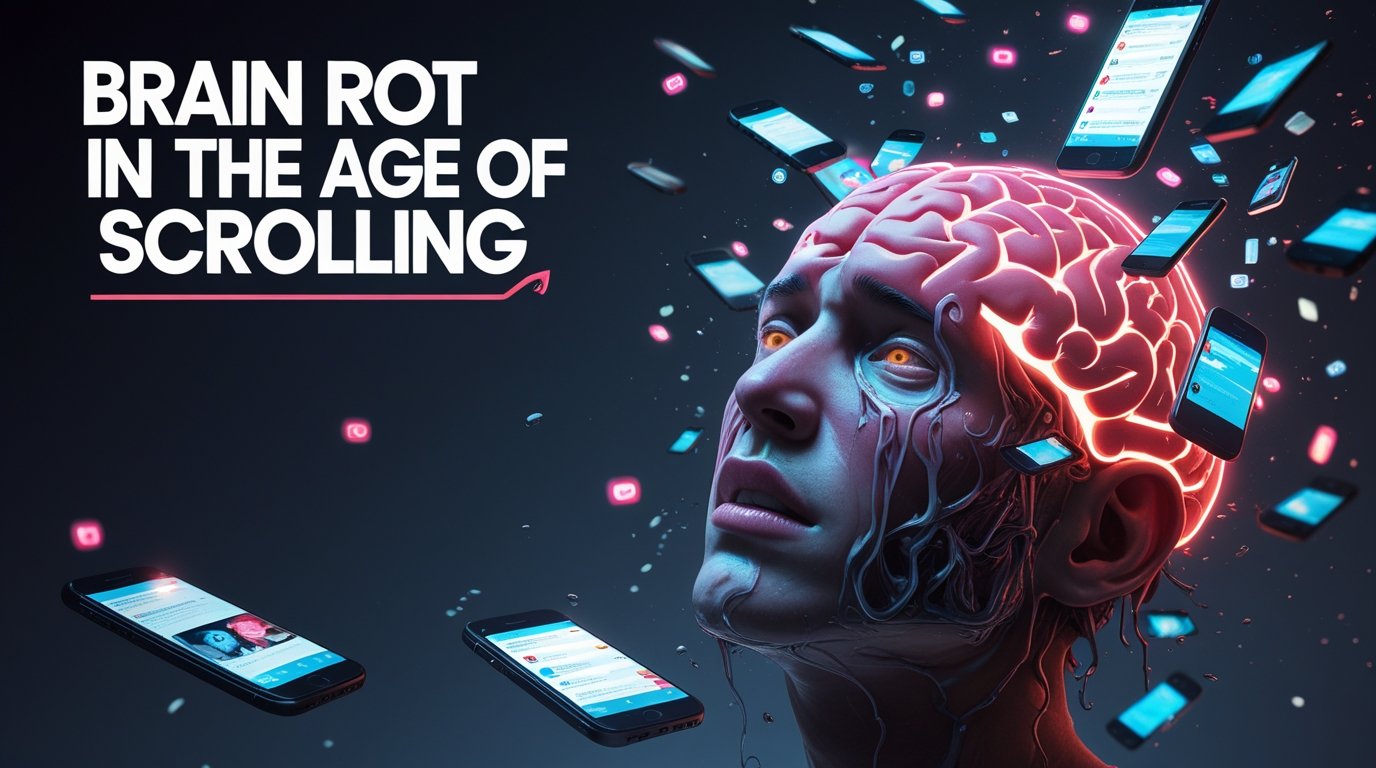
It’s midnight. You pick up your phone for “just five minutes.” One meme turns into a reel, then a clip from a trending song, then a movie scene, then an interview, then another joke. Suddenly, it’s 1:00 AM. You put your phone down and ask yourself a simple question: What was the first video I watched?
You can’t remember.
This isn’t just forgetfulness. It’s a pattern. And it has a name: brain rot.
In today’s hyper-digital world, excessive consumption of low-quality, fast-paced content is quietly reshaping our attention span, memory, and cognitive performance. This blog explores what brain rut really is, how digital brain rewiring works, and practical, science-backed steps to regain your focus.
What Is Brain Rot?
Brain rut refers to the mental fatigue and cognitive slowdown caused by continuous exposure to short-form, high-stimulation content. While the term gained popularity in online discussions, the underlying phenomenon is supported by research on attention, dopamine regulation, and neuroplasticity.
Studies from institutions like the University of California, Irvine suggest that average on-screen attention spans have dropped dramatically over the past two decades. In the early 2000s, people could stay focused on a screen task for over two minutes. Today, that number has fallen to under a minute.
At the same time, global screen time has skyrocketed. Adults spend over six hours daily on screens, and teenagers often exceed nine hours. A significant portion of that time is spent on short videos, social media feeds, and algorithm-driven platforms.
The result?
Constant cognitive fragmentation.
The Science Behind Digital Brain Rewiring:
Your brain is not static. It changes based on how you use it. This process is called neuroplasticity.
University of California, Irvine research highlights how interruptions and digital multitasking impair deep focus. When you frequently switch tasks, scroll, check notifications, and watch short clips, your brain adapts to that pattern.
Over time:
- Your tolerance for boredom decreases
- Deep reading becomes harder
- Long conversations feel exhausting
- You crave faster stimulation
This happens largely due to dopamine.
Dopamine isn’t just about pleasure. It’s about motivation and learning. Historically, it helped humans survive by finding food, forming bonds, and responding to threats. But modern technology hijacks this system.
Notifications, likes, and endless scrolling create unpredictable rewards. Your brain treats them like survival signals. The more you scroll, the more your dopamine baseline shifts. Normal activities, such as reading a book, studying, or even watching a full movie, begin to feel “boring.”
Children, Screens, and Cognitive Impact:
One frequently discussed example is Cocomelon, a wildly popular children’s YouTube channel known for its bright colors, rapid scene changes, and nonstop music.
Content like this is engineered to maximize engagement. Constant visual and auditory stimulation keeps children glued to screens. Many parents report irritability, reduced focus, and difficulty transitioning to other tasks after prolonged viewing.
Some neurological studies suggest that excessive screen exposure in young children may affect the development of the prefrontal cortex, the region responsible for decision-making, impulse control, and focus.
Experts often recommend minimizing screen exposure for children under three years old and limiting it carefully for older children. The developing brain is especially sensitive to overstimulation. But here’s the important part: adults are not immune.
The Google Effect and Cognitive Offloading:
Another modern issue is cognitive offloading, often called the “Google effect.”
When your brain knows information is easily searchable, it becomes less motivated to store it. Instead of remembering facts, we remember how to find them.
This shifts our cognitive strategy from knowledge retention to navigation skills. While search skills are useful, creativity depends on memory. New ideas form when old memories connect in novel ways.
If you don’t store information deeply, your creative capacity may weaken. Some research has even linked excessive screen time with structural changes in the cerebral cortex, the outer layer of the brain responsible for higher-level thinking. While research is ongoing, the correlation between heavy digital consumption and reduced deep-focus capacity is difficult to ignore.
Evolutionary Mismatch – Why Your Brain Is Vulnerable:
Human brains evolved over hundreds of thousands of years. For most of that time, we were hunter-gatherers. Our brains were designed to focus on survival-relevant signals and ignore distractions.
Then, in just a few decades, smartphones and social media entered the picture.
Marshall McLuhan famously said, “The medium is the message.” The form of communication shapes society more than the content itself.
Today’s digital medium favors:
- Vertical videos
- 15-second clips
- Endless feeds
- Algorithmic personalization
These formats reward speed, novelty, and emotional spikes. Algorithms are optimized for engagement, not cognitive well-being. This creates what scientists call a cognitive evolutionary mismatch. Our ancient brains are navigating a modern jungle of algorithms.
Signs You May Be Experiencing Brain Rot:
You might relate to some of these:
- You struggle to read more than 10 pages at a time
- You check your phone nearly 100 times a day
- You feel irritated when Wi-Fi is slow
- You watch videos at 1.5x or 2x speed
- You forget what you were about to say mid-conversation
If so, you’re not alone. But the good news is this: the same neuroplasticity that allowed your brain to adapt negatively can help it recover.
How to Reverse Brain Rot and Improve Focus:
1. Admit the Problem:
Awareness is the first step. Track how often you check your phone. Most people underestimate their usage.
Use screen time tracking tools. Seeing the number in front of you creates accountability.
2. Progressive Overload for Attention:
Think of focus like a muscle. If you’ve trained your brain for 30-second reels, you can’t expect to read a 500-page book in a single sitting.
Start small:
- Read 10 minutes daily.
- Increase to 15 minutes next week.
- Then 20 minutes.
Gradually rebuild your neural pathways.
3. Design Your Environment for Focus:
Willpower alone rarely works.
- Keep your phone out of reach while working.
- Remove distracting apps from your home screen.
- Use website blockers if necessary.
Reduce friction for good habits. Increase friction for distractions.
4. Start Your Day with Low Stimulation:
The first hour after waking up sets your dopamine tone.
Avoid:
- Scrolling
- Notifications
- News overload
Instead try:
- Meditation
- Walking without your phone
- Reading
- Planning your day in silence
This prevents an early dopamine spike that drives craving all day.
5. Dopamine Rebalancing:
Spend at least 1 hour daily in intentional low-stimulation.
No:
- Phone
- TV
- Podcasts
- Music
Just your thoughts.
Initially, boredom may feel uncomfortable. That discomfort is part of resetting your dopamine baseline.
6. Remove Triggers:
Turn off non-essential notifications.
Switch your phone to grayscale mode. Removing bright colors reduces compulsive engagement. The device becomes less stimulating, exactly how it should be.
7. Engage in Real-World Activities:
Physical and skill-based activities demand real focus.
Examples:
- Playing cricket
- Going to the gym
- Cooking
- Photography
- Learning guitar
These activities require coordination, problem-solving, and presence. They strengthen cognitive endurance.
8. Practice Mindful Consumption:
Before opening any app, ask:
- What is my intention?
- Am I bored?
- Am I avoiding something?
- Do I want to learn or just escape?
Replace digital junk food with nourishing content. Long-form podcasts, books, and educational videos can stimulate deeper thinking.
The Seven-Day Attention Reset Challenge:
Try this structured reset:
Day 1: Track your screen time.
Day 2: 10 minutes of uninterrupted reading.
Day 3: Turn off non-essential notifications.
Day 4: Start your morning without your phone.
Day 5: One hour of intentional low stimulation.
Day 6: Engage in a real-world hobby.
Day 7: Reflect and measure your attention improvements.
Small changes compound. Even minor improvements in seven days can create dramatic shifts over seven months.
Final Thoughts:
Brain rut isn’t about intelligence loss. It’s about environmental overload. The modern world is engineered to capture your attention. But your brain is flexible. Neuroplasticity works both ways. If scrolling can rewire your brain negatively, intentional habits can rewire it positively.
Improving focus won’t be easy. You’ll experience boredom. You’ll feel discomfort. But that discomfort is growth. If you’ve read this far, you’re already ahead of most people. The question now is simple:
Will you scroll or will you reset?
FAQs:
