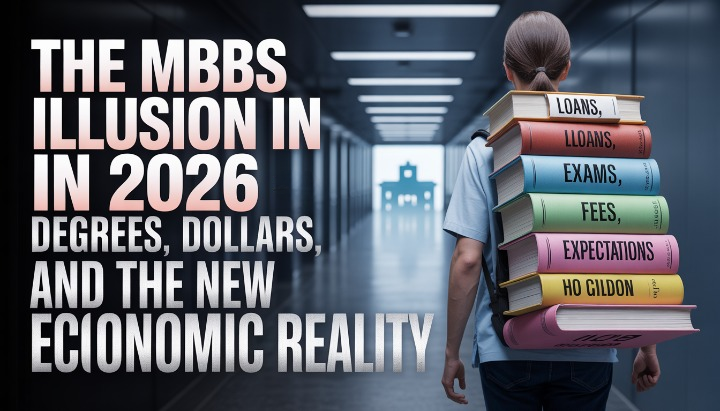
There was a time in Pakistan when becoming a doctor almost guaranteed you a stable, respected, upper-middle-class life. For decades, an MBBS degree was not just an academic qualification; it was a social status symbol. Families felt proud. Communities showed respect. Financial stability seemed certain. But in 2026, that promise deserves to be questioned.
This blog is not about disrespecting doctors or undermining medicine as a noble profession. It is about analyzing economic reality. It is about understanding return on investment, opportunity cost, currency devaluation, and leverage in a world that has fundamentally changed. If someone spends 50 to 80 lakh rupees and eight prime years of their life pursuing a degree, it is only rational to ask whether the financial model still makes sense.
Let’s break it down honestly, logically, and without emotional bias.
The Promise That Died in 2008:
In the 1970s, 80s, and even early 2000s, becoming a doctor in Pakistan was one of the safest bets you could make. An MBBS degree meant social respect, financial predictability, and long-term security. Your father’s generation saw doctors, engineers, and government officers living stable lives with strong purchasing power. Their salaries could support entire households comfortably.
But the economic system that supported that promise no longer exists in the same way.
The Pakistani rupee has depreciated significantly over the past two decades. In 2000, 10 million PKR had far stronger global purchasing power than it does today. Back then, it was worth around $160,000. Today, the same amount is roughly around $35,000. That means the global value of rupee-based income has dramatically weakened.
Yet the cost of medical education has increased massively.
Private medical colleges once charged around 50 lakh PKR for the entire MBBS program. Today, annual fees can range between 25 and 30 lakh per year, pushing the total cost toward or beyond 1 crore rupees. That’s before residency, exam fees, living expenses, and opportunity costs, and after eight years of study and training, what is the starting income for many doctors in Pakistan? Around 120,000 PKR per month. In dollar terms, that’s roughly $400 to $430.
Now ask yourself honestly: Does that income justify the financial and time investment?
This isn’t an emotional argument. It’s math.
Cognitive Dissonance and Emotional Attachment to Degrees:
The reason this conversation feels uncomfortable is not that it’s incorrect. It feels uncomfortable because of cognitive dissonance.
From childhood, we are told that traditional careers are the safest path to success. Doctor, engineer, CSS officer, lawyer. These titles become part of our identity. We don’t just believe in them; we attach our self-worth to them.
So when someone questions the financial value of these degrees in today’s economy, it feels like a personal attack.
But questioning a system is not disrespect. It is maturity.
If someone chooses medicine because it is their true calling, that is admirable. The world needs excellent doctors. But if someone chooses medicine purely for financial freedom and security, then it is necessary to re-evaluate whether the numbers still support that goal, respect does not pay bills. Prestige does not protect against inflation. And identity should not blind us to economic reality.
The Real ROI Nobody Calculates:
When calculating return on investment, most people only consider salary. They rarely consider opportunity cost.
Let’s look at the full picture.
Five years of MBBS. Three years of residency. That’s eight years between ages 18 and 26, arguably the most energetic, risk-tolerant, and flexible years of life. Add to that 50 lakh to 1 crore rupees in tuition fees and related expenses.
Now compare that with a 120,000 PKR monthly income at age 26 or 27.
What if that same 1 crore rupees were invested in a business, skill development, or assets? What if those eight years were spent building leverage instead of preparing to sell time?
The modern economy rewards leverage. Leverage means building systems, assets, or skills that are not limited by your physical presence. It means earning beyond the direct exchange of hours for money.
A person who learns a high-income digital skill and secures clients internationally can earn in USD. Even a $3,000 monthly retainer equals nearly 900,000 PKR. That is several times the starting salary of a doctor in Pakistan. The difference is not intelligence. The difference is economic model.
Intelligence Without Leverage Is Expensive Labor:
Medical students are not unintelligent. In fact, they are often among the most academically capable individuals in the country. Clearing entry tests and surviving medical school requires discipline and intelligence.
But intelligence without leverage turns into expensive labor.
Doctors sell time. Ten-hour shifts. Night calls. Emergency duty. Hospital politics. Their income is directly tied to their physical presence. If they stop working, income stops.
That is labor.
In contrast, someone who builds an online business, digital agency, content brand, software product, or international consulting service can decouple income from time. They can automate systems. Hire teams. Serve global clients.
That is leverage.
After 2020, the world experienced a massive digital shift. Remote work, global freelancing, international clients, online education, and digital services all became mainstream. Yet many traditional career discussions in Pakistan still operate under a pre-2008 mindset. The playbook was never updated.
The Three Freedoms That Matter:
Three types of freedom define modern wealth: financial freedom, time freedom, and location freedom.
A doctor in Pakistan may eventually achieve financial stability after many years of practice, especially after specialization. But time freedom remains limited because income is tied to shifts and physical presence. Location freedom is nearly impossible because practice requires being physically present in hospitals or clinics.
In contrast, digital businesses offer potential for all three freedoms.
Financial freedom because income can scale beyond local currency limitations.
Time freedom because systems and teams can operate without constant presence.
Location freedom because work can be done from anywhere with a laptop and internet connection.
The question is not which path is morally superior. The question is which model aligns with your goals. If your goal is to become a world-class surgeon and save lives, then medicine is the correct path. If your goal is financial independence and global earning power, then you must analyze whether medicine alone can realistically provide that in today’s currency environment.
Respect vs Reality
Society often glorifies struggle in traditional professions. Long hours, sleepless nights, and intense competition are praised as noble sacrifices, but rarely does anyone ask whether the individual is fulfilled. Whether they feel secure about the future. Whether they believe their financial growth matches their effort.
At the same time, young entrepreneurs are often criticized. Called unrealistic. Accused of taking unnecessary risks, yet the global economy is increasingly rewarding those who understand digital leverage, respect feels good. But respect cannot pay tuition fees, household expenses, or hedge against currency devaluation. Economic awareness is not rebellion. It is survival.
Ten Years Later – A Tale of Two Paths:
Imagine two classmates.
One completes MBBS, residency, and becomes a senior doctor at 36. They may earn 300,000 to 500,000 PKR per month, depending on specialization and experience. That is respectable. But income is still tied to time.
The second classmate spent early years building digital skills, online businesses, or international client networks. By 36, they may have multiple income streams, automated systems, and earnings denominated in dollars.
This is not fantasy. It is the difference between labor and leverage, and here is the difficult truth: the eight years spent in a rigid system cannot be reclaimed. Time is the only non-renewable asset.
This Is Not About Dropping Out:
This conversation is not an attack on medicine. It is not advised to drop out blindly. If you are deeply passionate about becoming a doctor and genuinely want to excel in the field, then go all in. Become exceptional. Specialize. Innovate. Stand out globally.
But if you chose medicine purely for financial security, then you owe it to yourself to question whether that security still exists in the same form. The rules for financial freedom have changed. Currency devaluation is real. Global markets are accessible. Digital skills are scalable. Income can now be international from day one.
A degree will get you a job. But in 2026, a job alone may not build wealth.
The core question is simple: are you pursuing your path out of passion or conformity?
Awareness is the first step toward transformation.
You do not have to abandon your degree. But you must understand the economic model you are entering. If necessary, build skills alongside your studies. Explore digital leverage. Hedge against local currency risk. The old promise may be fading. But new opportunities are emerging for those willing to see them clearly. The system changed. The question is whether you are willing to update your playbook
Conclusion:
The idea that an MBBS degree automatically guarantees financial security and a comfortable life is no longer as reliable as it once was. The economic landscape of 2026 has shifted dramatically. Currency devaluation, rising education costs, and changing global opportunities have reshaped what “success” looks like. What used to be a safe and predictable path now requires deeper analysis and conscious decision-making.
This does not diminish the value of medicine as a profession. Doctors remain essential, respected, and impactful members of society. However, respect alone is no longer enough to justify the financial and time investment if the primary goal is wealth creation or financial independence. The modern economy rewards leverage, global exposure, and scalable skills, factors that traditional career paths may not always provide on their own.
The key takeaway is not to reject medicine, but to approach it with clarity. If your motivation is passion, purpose, and a genuine desire to serve, then the path is meaningful and worth pursuing wholeheartedly. But if your goal is financial growth and freedom, then relying solely on a traditional degree may not be sufficient anymore.
Ultimately, this is about awareness. Understanding the difference between labor and leverage, between local income and global earning potential, and between outdated beliefs and present realities. The system has evolved, and success now depends on how well you adapt to that evolution. Your career should be a conscious choice, not an inherited assumption.
FAQs:
1. Is MBBS still a good career choice in Pakistan in 2026?
Yes, it can be a good career choice but it depends on your goals. If you are passionate about medicine and committed to long-term growth, specialization, or even working abroad, it can be rewarding. However, if your primary goal is quick financial success, the current economic model may not align with those expectations.
2. Why is the return on investment (ROI) of MBBS being questioned today?
The ROI is being questioned due to rising tuition costs, long study duration, and relatively low starting salaries compared to global earning opportunities. When adjusted for inflation and currency devaluation, the financial returns may not justify the time and money invested, especially when compared to scalable digital careers.
3. Can doctors still achieve financial success in Pakistan?
Yes, but it often takes time. Higher earnings usually come after specialization, private practice, or building a strong reputation over many years. Financial success is possible, but it is typically slower and more dependent on experience compared to some modern digital or global income paths.
4. What are alternative career paths offering better financial leverage?
Careers in digital fields such as freelancing, software development, online businesses, content creation, and international consulting offer higher leverage. These paths allow individuals to earn in foreign currencies, scale income, and achieve time and location flexibility.
5. Should current medical students reconsider their decision?
Not necessarily. Instead of panicking or quitting, students should become more aware of the economic realities. They can consider building additional skills alongside their degree such as digital skills or entrepreneurship, to create multiple income streams and reduce reliance on a single career path.